Choosing a tractor by land size sounds simple. A small farm needs a small tractor, a large farm needs a large tractor, and the problem is solved.
In real farming, it rarely works that way.
Two farms can both cover 50 hectares and still need completely different tractors. One may grow vegetables on light, flat soil with narrow implements. The other may cultivate grain in heavy clay, pull wider tillage equipment, and work against short planting windows. The acreage is identical, but the required horsepower, traction, hydraulic capacity, and machine weight can be very different.
That is why land size should be treated as a starting point, not a final answer. The right farm tractor must match the land, the soil, the implements, the crops, and the amount of work that needs to be finished each day.
This guide takes a practical look at how to choose tractor horsepower for different farm sizes without buying too little power, paying for capacity you will never use, or ending up with a machine that does not fit the way your farm actually works.
Start with Farm Size, Then Look at the Work Behind the Numbers
Farm size matters because larger operations usually need to cover more hectares within the same planting, tillage, or harvesting window. A tractor that can technically complete the work may still be too small if it takes too many days to finish the job.
But acreage alone is not enough.
Why the Same Number of Hectares Can Mean Different Tractor Needs
Imagine two 40-hectare farms.
The first grows vegetables and forage crops on light soil. Most of its work involves mowing, spraying, light tillage, transport, and PTO equipment. A tractor around 70HP may be entirely adequate.
The second grows corn and wheat on heavy clay and performs primary tillage with larger implements. That farm may need 100HP or even 160HP to maintain acceptable working speed.
The difference comes from the work, not the map.
Before choosing horsepower, consider:
- Soil type and soil resistance
- Flat, rolling, or hilly terrain
- Crop type and production system
- Largest implement you plan to use
- Required working depth
- Annual working hours
- Road transport distance
- Future expansion plans
A Practical Horsepower Range by Farm Size
The table below gives a useful starting point. It is not a strict formula, but it helps narrow the field before looking at soil, implements, and workload.
| Farm Size | Typical Tractor Range | Common Applications | Main Buying Priority |
|---|---|---|---|
| Under 10 hectares | 40–70HP | Orchards, mowing, spraying, vegetables, transport | Maneuverability and versatility |
| 10–30 hectares | 70–100HP | Mixed farming, plowing, seeding, PTO work | One tractor for multiple jobs |
| 30–80 hectares | 100–160HP | Tillage, planting, loader work, crop transport | Field capacity and implement matching |
| 80–200 hectares | 160–240HP | Heavy tillage, wide implements, commercial farming | Daily productivity |
| Over 200 hectares | 240–440HP+ | Large-scale cultivation, deep tillage, wide seeders | Maximum field efficiency |
The important word here is typical. A 20-hectare orchard and a 20-hectare grain farm do not necessarily need the same tractor. Neither do two 200-hectare farms with different soil types, implement widths, and operating schedules.
For Small and Medium Farms, Versatility Usually Matters More Than Maximum Power
Small and medium farms often ask more from one tractor than large commercial operations do. The same machine may plow a field in the morning, move feed in the afternoon, operate a mower the next day, and pull a trailer during harvest.
That makes balance more important than raw horsepower.
Under 10 Hectares: Do Not Buy Size You Cannot Use
For orchards, vegetable farms, livestock yards, and compact mixed operations, maneuverability is often more valuable than extreme pulling force.
A tractor in the 40HP to 70HP range can handle many common jobs:
- Rotary tillage
- Spraying
- Mowing
- Fertilizer spreading
- Trailer transport
- Loader work
- Light plowing
At the upper end of this range, a 70 horsepower tractor offers enough capability for serious daily farm work without becoming unnecessarily large for narrow fields or confined spaces.
For buyers working orchards or irregular plots, tractor width, turning radius, tire choice, and transmission can matter as much as engine output.
10 to 30 Hectares: The 70HP to 100HP Sweet Spot
This is where many mixed farms find their ideal tractor size.
A 70HP machine may be enough for lighter cultivation, transport, spraying, mowing, and common PTO jobs. Moving to a 100 horsepower tractor gives more room for wider implements, heavier trailers, stronger loader performance, and future expansion.
The question is not simply whether 100HP is better than 70HP. It is whether the extra power will actually be used.
If the tractor regularly works under heavy load, pulls larger cultivation equipment, or needs to finish field work faster, 100HP can make sense. If most work is light-duty and fields are small, the extra cost may not deliver much return.
When 4WD Is More Valuable Than More Horsepower
One of the most common buying mistakes is assuming that more horsepower always solves traction problems.
It does not.
A 4WD farm tractor can often use available engine power more effectively than a higher-horsepower 2WD machine, especially in:
- Wet fields
- Heavy clay
- Sloping land
- Loader work
- Deep cultivation
- Conditions with frequent wheel slip
For many farms, choosing 4WD, correct ballast, and proper tires improves real field performance more than simply adding another 20 or 30 horsepower.
Buyers comparing tractors for small and medium farms can explore the King-Gold Dafeng farm tractor range for models suited to field work, orchard use, transport, PTO applications, and mixed farming.
As Farm Size Grows, Time Becomes the Real Limiting Factor
Once a farm reaches a certain scale, the question changes.
It is no longer:
Can this tractor pull the implement?
The better question becomes:
Can this tractor complete the work within the available field window?
A smaller tractor may still be capable of doing the job, but capability and productivity are not the same thing.
30 to 80 Hectares: 100HP or 160HP?
At this size, the correct choice often depends on soil conditions and implement width.
A 100HP tractor may be enough for moderate tillage, planting, loader work, and transport on lighter soils. But when fields are heavier, implements are larger, or operating windows are short, moving to 160HP can noticeably improve daily output.
A 160 horsepower tractor becomes particularly useful when the farm regularly handles:
- Heavy cultivation
- Large seed drills
- Commercial transport
- Long daily working hours
- Wider PTO equipment
- Growing acreage
This is also where future planning becomes important. A tractor that is perfectly sized today may become the farm’s bottleneck after acreage expands or larger implements are purchased.
80 to 200 Hectares: Field Capacity Starts to Matter More
At this scale, a tractor has to do more than pull. It has to cover ground efficiently.
Farms in this range often move toward 160HP to 240HP machines because wider implements reduce passes and help complete land preparation or planting within tighter schedules.
A 240 horsepower tractor is especially relevant for:
- Broad-acre grain production
- Heavy soil
- Deep cultivation
- Large disc harrows
- Wide seeders
- Agricultural contracting
The gain is not only more pulling force. It is fewer passes, higher daily acreage, and less risk of losing valuable time when weather conditions change.
Over 200 Hectares: Matching Power to Commercial-Scale Work
Large farms require a different way of thinking. At this scale, the tractor becomes part of a production system. Engine power, hydraulic output, traction, transmission, implement size, fuel consumption, and operator comfort all affect total field efficiency.
For heavy commercial agriculture, 240HP may be the starting point rather than the upper limit.
Operations using very wide implements, deep tillage equipment, or working difficult soil may benefit from machines in the 300HP to 440HP range and above.
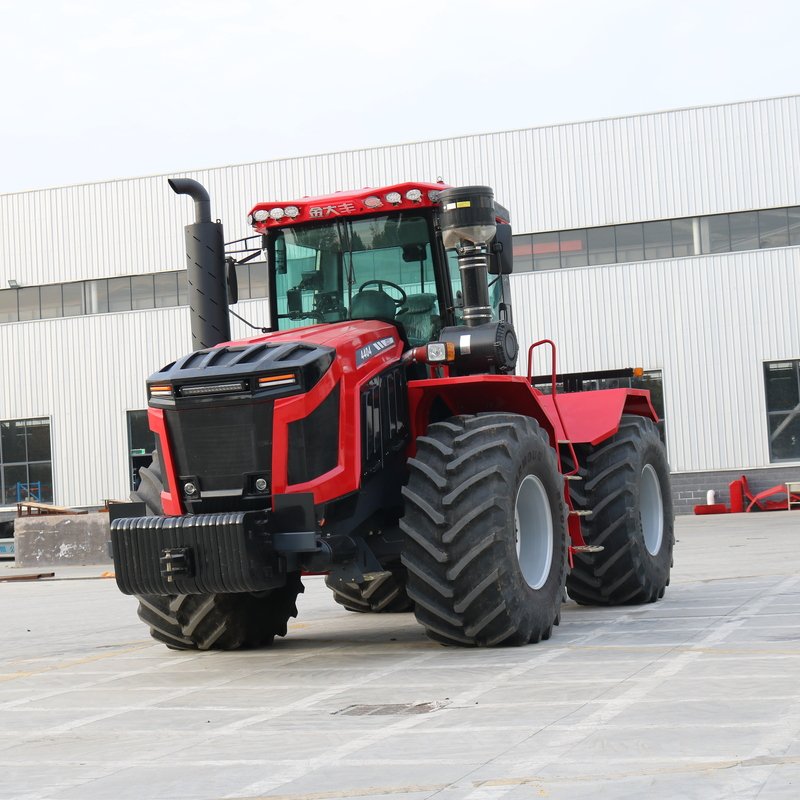
For these applications, the King-Gold Dafeng 440HP tractor is designed for heavy soil, deep tillage, large fields, wide implements, and demanding commercial agricultural work.
| Farm Situation | Likely Power Range | Why |
|---|---|---|
| Light soil, moderate acreage | 100–160HP | Good balance of power and operating cost |
| Heavy soil, medium-large farm | 160–240HP | Better traction and stronger pulling performance |
| Large grain farm | 240HP+ | Supports wider implements and faster field coverage |
| Large commercial operation | 240–440HP+ | Designed for deep tillage and long working days |
The Largest Implement Often Tells You More Than the Land Size
When buyers are unsure between two horsepower ranges, one practical method is to look at the most demanding implement the tractor will use.
A tractor does not work in isolation. It works as part of a tractor-implement combination.
Start with the Hardest Job on the Farm
Think about the job that places the greatest demand on the tractor.
Is it:
- Deep plowing?
- A large disc harrow?
- A subsoiler?
- A wide seed drill?
- A heavy trailer?
- A high-capacity PTO machine?
That task often sets the minimum practical tractor size.
A tractor that handles 90% of the farm’s work easily but struggles badly with the most important seasonal job may still be undersized.
Heavy Soil Changes the Equation
Soil resistance can dramatically increase power requirements.
Light, dry soil allows a tractor to pull an implement more easily. Heavy clay, wet ground, or deep cultivation requires more traction and engine reserve. This is why horsepower recommendations should never be copied blindly from another farm.
In difficult soil, consider:
- More horsepower
- 4WD
- Correct ballast
- Larger agricultural tires
- Reduced implement width if necessary
Hydraulic Capacity Can Be the Hidden Limitation
Some buyers focus so heavily on horsepower that they overlook hydraulics.
Modern seeders, planters, loaders, and large mounted implements may require significant hydraulic flow or lifting capacity. A tractor may have enough engine power to pull an implement but still lack the hydraulic performance to operate it properly.
Before buying, check:
- Hydraulic flow
- Rear lift capacity
- Number of hydraulic outlets
- PTO speed and output
- Implement weight
Five Questions That Usually Lead to the Right Tractor Size
Instead of starting with a horsepower number, start with five questions.
1. How Much Land Must Be Covered?
Larger acreage generally requires more field capacity, especially when planting or tillage must be completed within a narrow seasonal window.
2. What Is the Hardest Job?
The most demanding operation usually determines the minimum practical power level.
3. What Is the Largest Implement?
Implement width, weight, PTO demand, and hydraulic requirements should all be checked before choosing the tractor.
4. What Are the Soil and Terrain Conditions?
Heavy soil, hills, mud, and uneven ground increase the importance of traction and may justify 4WD or additional horsepower.
5. Will the Farm Grow?
Buying exactly enough tractor for today may create another purchasing decision in a few years. Some reserve capacity is useful, especially for growing operations.
But there is a limit. Buying far more tractor than the farm can use may increase:
- Fuel consumption
- Tire costs
- Maintenance expense
- Soil compaction
- Purchase investment
The goal is not to buy the biggest tractor the budget allows. It is to buy enough tractor to complete the work efficiently, with reasonable room for growth.
A Practical Recommendation by Farm Type
Land size is useful, but farm type often gives the final clue.
| Farm Type | Typical Tractor Range | What Matters Most |
|---|---|---|
| Orchard | 50–70HP | Maneuverability, width, PTO performance |
| Small Mixed Farm | 70–100HP | Versatility and daily usability |
| Growing Family Farm | 100–160HP | Capacity for larger implements and expansion |
| Medium Grain Farm | 160–240HP | Tillage efficiency and field coverage |
| Large Commercial Farm | 240–440HP+ | Wide implements, heavy tillage, long working hours |
A 70HP tractor may be ideal for a smaller mixed farm. A 100HP machine can offer more flexibility and room to grow. A 160HP tractor can support demanding medium-scale farming, while 240HP becomes attractive for large fields and heavy tillage.
For the biggest commercial operations, especially those using wide implements in difficult soil, 440HP can provide the pulling strength and field capacity required for serious large-scale agriculture.
Choose the Tractor That Fits the Work, Not the Largest Number
There is no universal tractor horsepower for a given number of hectares.
A farm’s real needs depend on the relationship between land size, soil resistance, implement width, working depth, operating hours, and future plans.
That is why the best tractor is not necessarily the smallest machine that can complete the job, nor the largest machine you can afford. It is the one that finishes important work on time, matches your implements properly, and leaves enough capacity for realistic future growth.
King-Gold Dafeng offers agricultural tractors across multiple horsepower ranges for orchard work, mixed farming, field cultivation, heavy tillage, and large-scale commercial agriculture. Buyers can explore the agricultural tractor collection to compare available configurations and find a tractor suited to their land, implements, and working conditions.