When shopping for a new tractor, one question comes up again and again: Should I buy a 4WD farm tractor or will a 2WD model do the job?
For decades, four-wheel drive has become increasingly common on modern agricultural tractors. Better traction, improved stability, and stronger pulling performance make 4WD attractive for many farmers. However, that doesn’t automatically mean every farm needs one.
The right choice depends on your land, soil conditions, implements, daily workload, and future expansion plans. In this guide, we’ll explain when investing in a 4WD farm tractor makes sense—and when it may simply increase your operating costs without delivering significant benefits.
What Does 4WD Actually Do?
A four-wheel-drive tractor transfers engine power to both the front and rear wheels. Instead of relying only on the rear axle for traction, all four wheels work together to move the machine forward.
This additional traction helps reduce wheel slip, improves pulling efficiency, and allows the tractor to work more confidently on uneven ground or in difficult weather conditions.
Better Grip Means Better Productivity
Whenever a tractor loses traction, fuel is wasted. The engine continues producing power, but some of that energy disappears as spinning tires instead of moving the implement through the soil.
A 4WD tractor reduces wheel slip by distributing power more evenly, allowing more engine output to reach the ground.
Improved Stability Under Load
Modern farms regularly use heavier implements than they did twenty years ago. Front loaders, seed drills, balers, cultivators, and heavy trailers all place additional demands on the tractor.
With four driven wheels, the machine remains more stable while lifting, transporting, or pulling heavy equipment.
| Feature | 2WD Tractor | 4WD Tractor |
|---|---|---|
| Traction | Good | Excellent |
| Heavy Pulling | Average | Excellent |
| Wet Soil Performance | Limited | Excellent |
| Loader Work | Good | Better Stability |
| Sloping Land | Average | Much Better Control |
When Is a 4WD Tractor Worth the Investment?
Not every farm requires four-wheel drive, but there are situations where the benefits become immediately noticeable.
Heavy Soil Conditions
If your fields contain heavy clay or frequently remain wet after rainfall, traction quickly becomes one of the biggest limiting factors during field work.
A 4WD farm tractor maintains better grip, helping operators continue working with less wheel spin and better fuel efficiency.
Large Implements
The wider the implement, the more pulling force is required. Disc harrows, cultivators, subsoilers, and large planters all benefit from the extra traction provided by four-wheel drive.
Hilly or Uneven Terrain
Working on slopes requires stability as well as power. Four-wheel drive improves steering control while reducing the risk of losing traction when climbing or descending uneven fields.
Front Loader Operations
Loader work places considerable weight over the front axle. A 4WD tractor distributes that load more effectively, improving steering, lifting performance, and overall safety.
How Horsepower Changes the Need for 4WD
The larger the tractor becomes, the more valuable four-wheel drive generally becomes. While smaller utility tractors may still perform well in 2WD configurations, medium and high-horsepower tractors often gain significant performance advantages from driving all four wheels.
70HP Tractors
For orchard work, light cultivation, and transport on dry land, 2WD may still be sufficient. However, farmers working in wet fields or using loaders often prefer 70HP 4WD tractors for their improved traction.
100HP Tractors
Once horsepower reaches around 100HP, many buyers begin choosing 4WD as the standard configuration. The additional pulling capacity makes field work noticeably easier, particularly when using larger implements.
160HP and 240HP Tractors
In these horsepower classes, four-wheel drive is no longer simply an option—it often becomes the practical choice for commercial farming. Heavy tillage, deep cultivation, and large-scale planting demand reliable traction throughout long working days.
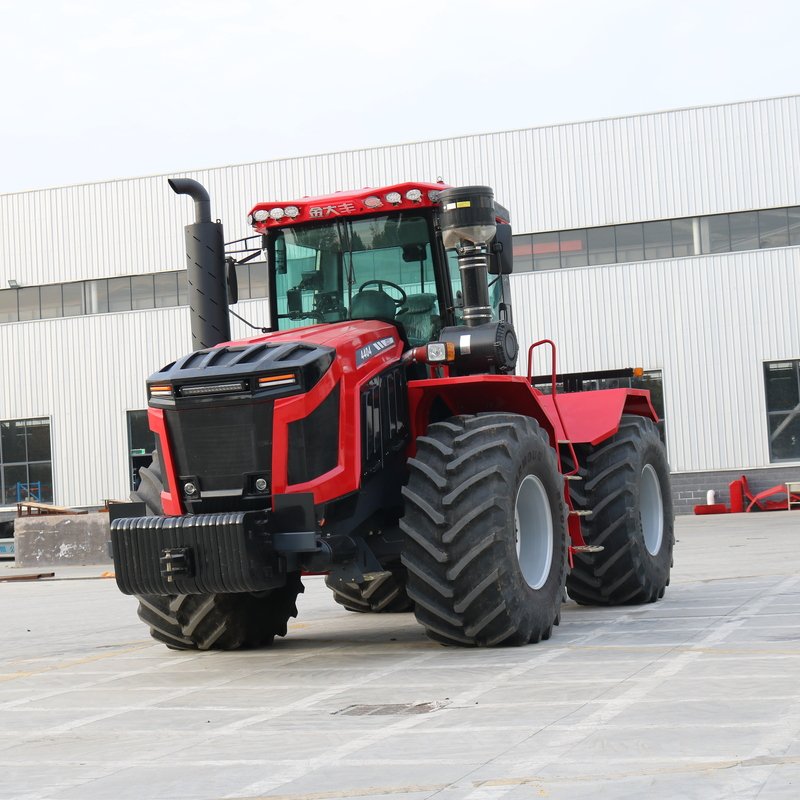
440HP High-Horsepower Tractors
For machines in the 400HP class, four-wheel drive is essential. Large commercial farms rely on maximum traction to transfer enormous engine power into productive field work.
If you’re exploring different tractor sizes and configurations, our agricultural tractor lineup includes models designed for everything from everyday farm work to heavy commercial operations.
Situations Where 2WD May Still Be the Better Choice
Although 4WD has many advantages, it isn’t always the best solution.
For smaller farms with flat terrain, light-duty transport, or basic PTO applications, a 2WD tractor may provide everything required while keeping purchase costs and maintenance expenses lower.
Choosing the right tractor isn’t about selecting the most advanced specification. It’s about selecting the machine that matches your actual workload.
| Farm Condition | Recommended Drive Type |
|---|---|
| Flat Dry Fields | 2WD or 4WD |
| Heavy Clay Soil | 4WD |
| Hilly Terrain | 4WD |
| Loader Work | 4WD |
| Transport Only | 2WD Usually Sufficient |
| Commercial Farming | 4WD Strongly Recommended |
What Should Buyers Consider Before Choosing?
Think About Future Expansion
If your farm is expected to grow over the next several years, investing in a 4WD tractor today may save you from replacing equipment later.
Match the Tractor to Your Implements
Large implements place greater demands on traction than engine horsepower alone. Matching your drive system with your equipment often improves efficiency more than adding extra horsepower.
Consider Local Weather
Regions with frequent rainfall, muddy conditions, or soft soil generally benefit more from four-wheel drive than dry areas with firm ground.
Final Thoughts
So, do you really need a 4WD farm tractor? For many modern farms, the answer is yes—but not because four-wheel drive is fashionable. It improves traction, increases field productivity, reduces wheel slip, and helps tractors handle demanding work more efficiently.
For smaller farms with light workloads, a 2WD tractor may still be the more economical option. But as field sizes, implement widths, and daily workloads increase, the advantages of 4WD become increasingly clear.
King-Gold Dafeng offers agricultural tractors in multiple horsepower ranges to suit different farming conditions. Whether you’re looking for a practical utility tractor or a heavy-duty commercial machine, you can explore our farm tractor collection to compare configurations and choose the model that best fits your operation.